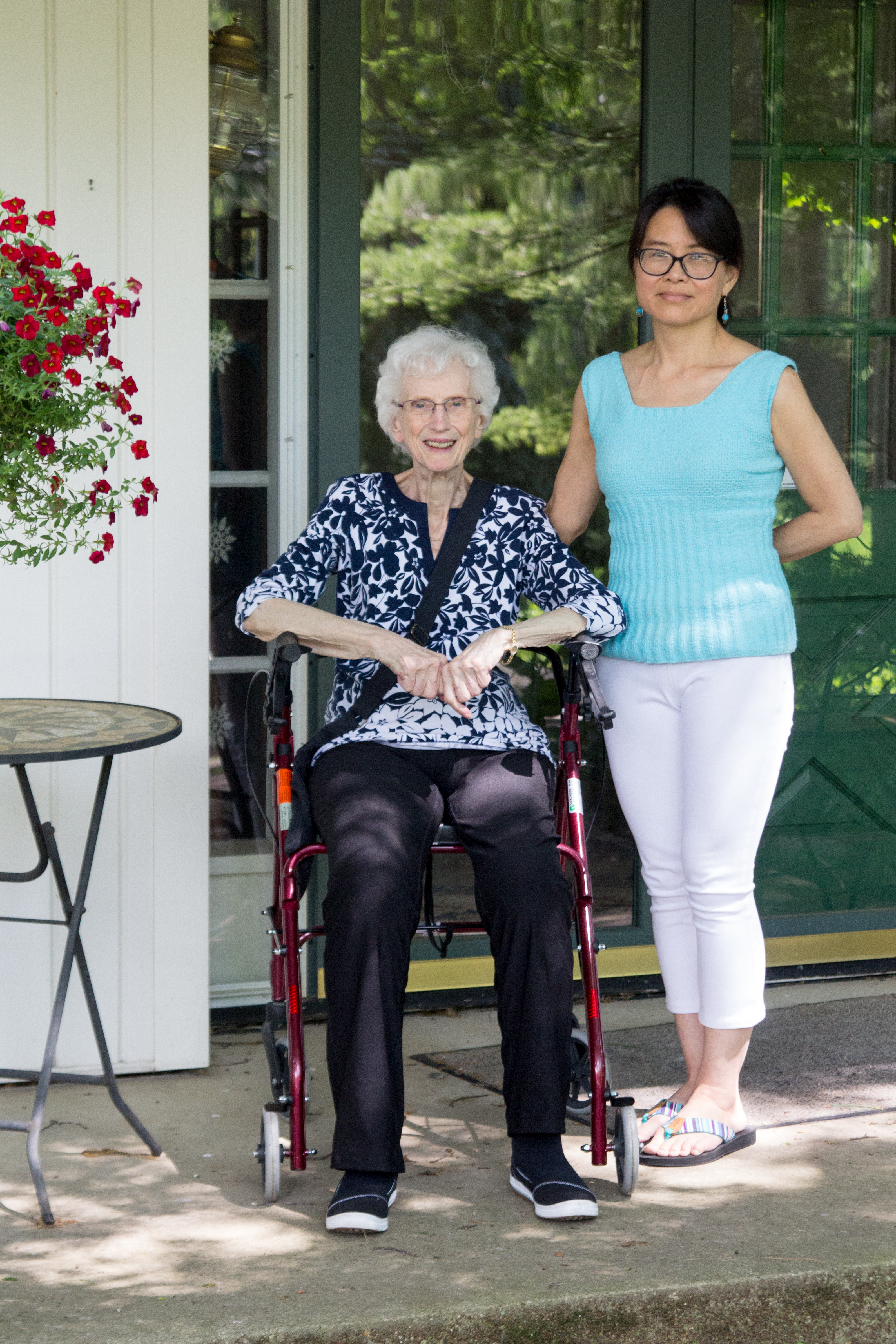
This is the fourth of Penny’s Cancerland essays. She was diagnosed with colon cancer in February, 2016, and had chemotherapy that summer and into the fall. This must have been written shortly after chemotherapy had wrapped up — and the real cancer journey began.
One morning when I shuffled into the kitchen, Andrew was cutting apart a cereal box. “I won!” he grinned. “I won an X-box!” If he had been still eight years old, I would have gently let him down, informing him that when the cereal box says, “You might be an instant winner!”, that doesn’t really mean YOU. But my Andrew was then 22, a college graduate, working part-time and taking advantage of various internship-like opportunities, while living at home and apparently eating a lot of chocolate-flavored Special K cereal. He was carefully filling out the voucher from the inside of the box and addressing an envelope to be sent via certified mail. I had no doubts that my slightly OCD son had read the fine print at least four times. I still warned him, “Well, we’ll see.”
A few months after my mother’s open-heart surgery –– the surgery one week after Dad passed away –– her doctors informed us that the ejection fraction was not improving as it should; tests indicated a lot of leakage especially around one of the valves they replaced. When pushed, the cardiologist took a deep breath, “You’ve got a year, maybe a little longer.”
We knew what going downhill looked like, which rehab centers we didn’t like, that food and service in short-term and long-term senior and rehab facilities vary widely. Sometimes you’re lucky and a nurse or nurse-tech is kind and personable and has the time and energy to show that to his or her patients. But we had memories too of arriving to visit Dad, only to find him alone at a table in a poorly lit corner picking at a plate of notably unappetizing variants on mush. Mom remembered pushing the call button and waiting for what felt like an eternity for someone to come and help her to the bathroom. It took so long, the sheets needed to be changed. The probably overworked nurse-techs weren’t any happier about that than Mom was.
So, when we got the sobering news “maybe a year,” we decided that no one wanted Mom to spend more time in facilities than absolutely necessary. I spent months looking for a house that could become a comfortable home for my family of five, our exchange students, and Mom. And the dog. We all knew that Gramma would do better if she and the dog and all the dog hair could be kept separate. Of course, Mom wanted some space that could be hers, to retreat away from the hubbub that comes with three teenagers and a 12-year-old. Who could blame her? Open floor plans are great unless you might possibly want some quiet and privacy. The house also had to be mostly accessible for walkers and wheelchairs. Why are all those “mother-in-law” apartments in the basement or the attic?
Finally, we found a house. It was ideally located, but one of the most boring-looking buildings you can imagine. Nevertheless we went for it. Note to self: two professors with four kids in tow should not try to dissolve two households and move into a house with a grandmother in the middle of a semester.
We bought Mom one of those hospital-like beds with the head and knee areas that you can adjust up and down. We had a doorway installed between the brightest room in the house and her bedroom, and we put in a gas fireplace, so she could rest in warmth all winter long. I had references for home health care providers at the ready and was prepared, if necessary, to take unpaid family medical leave to care for Mom near the end.
Six years later we’re still in this house. Two exchange students have come and gone. My niece who lived with us for 2 ½ years just moved to grad school. We’re on the verge of sending our youngest off to college. And Mom is still with us. She is dealing with bladder cancer and recently had another heart valve replaced with a miracle minimally invasive catheter procedure. But by all accounts, she beat the odds.
Odds are odd. My statistician husband finds them interesting, useful, logical. So, when my first pathology reports came back after surgery in February, and the doctor said that 85% of patients with my stats are cured — not “survive,” not go into remission, CURED — we breathed a huge sigh of relief. Knowing the stats made the following six months of chemotherapy more tolerable. In fact, I tolerated the chemo cocktails better than most.
One month after chemo ended, I was feeling better than I had since before the Mondulkiri Curse. I thought I was doing well; after all, the odds were with me. But the bloodwork raised red flags; the scans showed suspicious areas; the bad numbers kept rising. When pushed, the doctors suggested if we did nothing, I had months, maybe a year.
Just to be clear, I have a reasonable basic understanding about numbers, approximations, and even statistics. Lucky for me, “basic” gets enhanced by my in-home math geek husband. So, I never expect to win the X-box1 featured on the front of the cereal box. What are the chances of that? Likewise when the doctors told Mom she had a year, we took action to make it the best possible year — preparing to accompany her with grace and dignity, care and love, from third base to home plate. The doctor never said, “Oh, and there is also a some % chance she’ll live 5 – 10 years more.”
From my first pathology reports through the months of chemotherapy, I actually didn’t worry much. After all, the odds were with me. Ignorance is bliss. Now I wonder what the chances are that my mother will outlive me.
I never thought I of all people would be in that 15% of colon cancer patients like me who are not cured. People in their 40’s don’t generally get colon cancer. How many times did a hospital person look up from reading my medical chart and comment on how young I was or how I didn’t look old enough to have kids in college? Somewhere on my charts I’m described as a “younger female.” I guess that’s like skimming home ads and reading about “newer appliances.” In retrospect, “You look so young!” feels like an unconscious, well-meaning euphemism for “Wow, you’re really unlucky.”
Penny’s mother did not outlive her. But things were unclear enough that her mother redid her will to make things easier and “fairer” had it turned out that way.
In June of 2017, Penny’s mother underwent her last treatment for her cancer. There were no more things to try that would have had a reasonable chance of success and that her 85-year-old body with years of cancer treatments, open-heart surgeries, and medications could tolerate. The first week of July she entered hospice in our home, where she had lived with us for nearly six years.
The first couple weeks of hospice were busy. She was weak, and was losing weight, but she had enough energy to have all of her siblings visit one day, and all of her grandchildren the next. Each evening our family watched episodes of The Walton’s with her, and she shared stories from her childhood. She would have been about the same age as the youngest Walton, Elizabeth.
By mid-July, she was declining more rapidly. Then Penny ended up in the hospital with a bowel obstruction. Each morning I helped Penny’s mom get ready for the day before heading to the hospital to be with Penny while my mother sat with her mother. In the evening I came home to help her get ready for bed and to be there if she needed anything in the night.
On the last Wednesday of July, I called the hospital to tell Penny that I would be coming a bit later than usual. Her mother had died. Among the many things we had not imagined before arriving in Cancerland was the thought that I would be with her mother as she passed and Penny would not.