This is the fifth of Penny’s Cancerland essays. She was diagnosed with colon cancer in February, 2016. In this essay she reflects on her first round of chemotherapy, which began in April and continued for 12 biweekly infusions. We didn’t know it at the time, but over the next 8 years, she would go to the chemo depot more than 100 times.
The online Urban Dictionary’s top definition for “Kemosabe” reads: “An understanding of all that’s involved in chemotherapy.” Then they offer an example sentence: “When I first escorted my aunt to the clinic, I hadn’t a clue about the treatment – but now she’s all better and I’m all kemo-sabe.”
Really? I’m obviously out of touch with the world out of which The Urban Dictionary comes. With apologies to the students and colleagues who speak or are well-acquainted with the Navajo language, I think most folks I know connect “Kemosabe” with the very old Lone Ranger TV show. And, (a) yes, I know that “sabe” is related to “knowing” in Spanish, (b) a friend informed me that it’s supposed to sound like “chemo-savvy”, and (c) some us of also know that “kemosabe” really isn’t a term of endearment for masked white men riding horses.
Returning to this idea that someone after accompanying a relative through what is often a long journey of chemo treatment could be “all kemo-sabe,” I am dumbfounded at how the example sentence flirts almost whimsically with the experience of chemotherapy. If I let the patients I know sum up their therapy, I’m guessing a quarter of the descriptions should be banned from dinner conversations for the sake of everyone’s appetite, one-sixth of the descriptions would make this essay PG-13, and zero percent would choose words from other languages thought to be terms for your best buddy. A long list of variables, reactions, and adjustments en route make everyone’s chemo journey unique. Some folks get blasted pretty fast and furiously; others have chemical infusions twice a week or bi-weekly. One of my friends will get infused every three weeks for the rest of his life.
I do not want to downplay the suffering or challenges faced by women (and men) dealing with breast cancer, surgeries, reconstructions (or not), and chemo-induced hair loss. We all know or know of cancer patients who have lost all their hair. You can spy them, especially the women, in public. Folks, including my past self, donate hair to make wigs for them. And every time I go to that cancer center, there are hats galore for the taking – sewn, knitted, crocheted. In my many hours spent in medical buildings and offices, it’s not too hard to find support groups, salons, and catalogs of supply options for both hair loss and mastectomies. Who hasn’t seen the pink ribbons, fund-raising runs, TED talks, and whole conferences with famous guest speakers talking about breast cancer, body image, the BRCA gene, Angelina Jolie, Joan Lunden, etc.? Ever since brave First Lady Betty Ford made her breast cancer public, it’s completely okay to talk about this terrible disease.
In contrast, colon cancer is not an easy conversation topic. Yes, I want to complain. Whether around the water cooler or the dinner table, who wants to talk about intestines and, let’s be honest, poop? While the reconstruction of breasts fascinates a lot of folks, no one really wants the details of the re-plumbing, ostomy-issues, and changes in one’s poo associated with colon cancers and colectomies (the removal of the colon). If I do dare a chapter on these TMI topics, I’ll be sure to label it something obvious so you can skip it if you wish. I get it: even if the President of the United States got colon cancer and had a colectomy, we would still avoid talking about it over dinner.
On the other hand, infusion chemotherapy IS something you can describe to folks without too many grimaces and looks of “TMI!” So, here’s how my first six months of treatment went. Maybe something here will resonate with you, help you, or help you support a friend.
About two months after the surgery, I began a standard chemotherapy for colon cancers of my type. Every other Tuesday I would go to the chemo depot – rows of infusion cubicles each with a recliner for the patient, a chair for a friend, and a TV. (I have yet to turn on one of those TVs. Thank you, by the way, for being at this very moment a Reader and not a TV-only person.)
Every time I set foot on that floor or in that building, someone has to weigh me, take my blood pressure, and check my temperature. I know they’re following protocols, but it must be a very inexact science. For example, I think some techs have weighed me with jackets and coats on, including cell phone and keys in my pockets and boots on my feet, while other times I’m wearing a T-shirt, leggings, and crocs. In my guess-timate, the clothing differences can be a six-pound swing. Second, I tend towards low-blood pressures. If the numbers are too low, then they’ll check it again – sometimes three times – until they get a number they like. Finally, my temp can vary by about two degrees, but no one seems to care.
Once you get escorted to your cubicle for the day, you should always ask for a heated blanket.
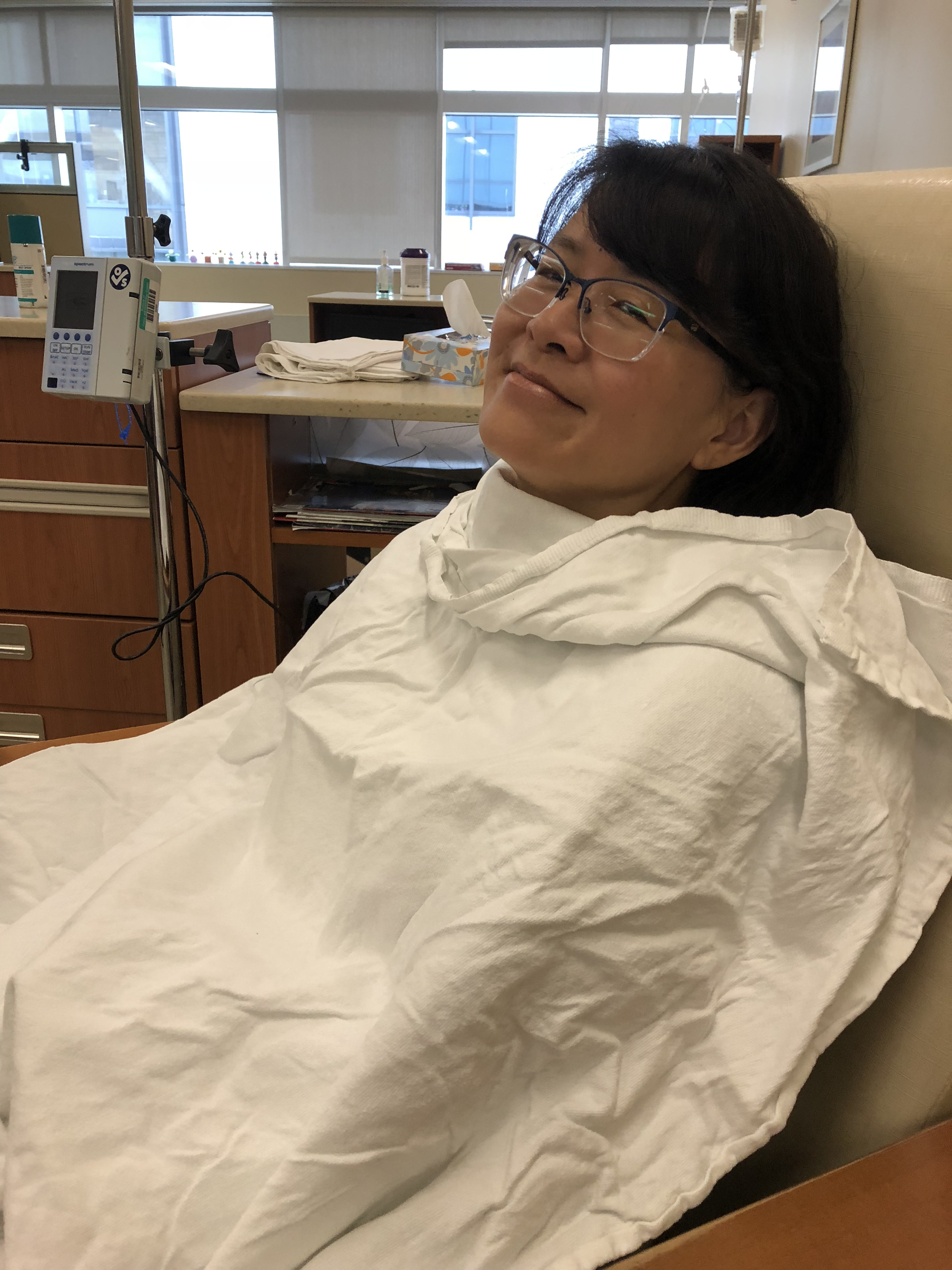
Whoever invented that idea and the little ovens that keep the blankets the perfect temperature should be nominated for some sort of Keeping-the-Peace prize. That warm bit of comfort and kindness keeps us all from crying as they poke us with needles, and whimpering as we realize it’s the start of another cycle of feeling disgusting, and possibly from swearing, moaning, or giving the evil eye when we are asked AGAIN what our pain number is.
In my experience, the set of pre-meds, chemical therapies, and post-meds, must all be confirmed and ordered at each visit. So you are stuck waiting around for the nurses to confirm with you that you still want to be poisoned that week; after that, the correct bags of meds in goo must be ordered from the pharmacy. When your batch of chemicals arrive, you get hooked up for hours of steroids, anti-nausea meds, chemotherapy cocktails, iron infusions, etc.
“Hooked up” is anything but sexy. A week before the infusion treatments began, I had a port surgically implanted about three inches below my right collar bone. You can see the tubing threaded from that superball-sized bump under my skin and over my collar bone; from there, I’m told, the tubing cuts into a huge artery or vein or something that feeds into my heart. Honestly for the first couple months when I looked in the mirror and could see those bumps and worm shapes under my skin, it gave me the creeps.
Anyway, getting hooked up involves inserting a needle with attached tubing into the port. You have the option of using some sort of icing spray to numb up the port area prior to puncturing. Freezing my skin sounds terrible to me, so I just grimace and bear it. It only hurts for about 30 seconds. Plus, I’ve heard that freeze spray is intense, “like icicles.” Part of me says: oh, come on, give it a try. The other part of me says: really? You do not want to trade the minor pain you know for an unknown pain of unknown level and duration.
After securing the special needle (which looks ironically like it has yellow butterfly wings) with clear adhesive rectangles, your specially-ordered bags of chemicals are hung nearby, tubes from those bags are fed through a small box that regulates flow rate, and then you sit in the recliner having various substances pumped into you and trying to forget how rotten you’ll feel later because of it all.
During your hours at the depot, there is the recurring excitement of the beeps. Your flow regulator beeps when it thinks there’s a bubble or an occlusion or an empty bag, and at times just because. Sometimes you get more than one box if they’re administering several drugs with different flow rates simultaneously. And all those boxes in all the cubicles in the whole chemo depot love beeping. The only comfort is that we all refer to them as “those beeping boxes!”
When all my bags were empty, then as a bonus I got to leave with a small pump that injected more healing poisons through tubes and my port over the following two days. You cannot disconnect the tubes from the pump or the tubes from your port at any time in those 48 hours. You are given instructions and a special bright yellow bag with symbols that look like radioactive danger signs, in case some part of your pump system becomes unhooked and you must scoop it all up ASAP and put it in the bag to prevent contamination of anyone else or the environment. I don’t know anyone who carries that substantial bright yellow bag everywhere they go. I misplaced mine shortly after the second infusion session.
Anyway, I named my pump “Buddy.” He came with the most ugly, bulky fanny pack I had seen since the 1980’s. As a one-size-fits-all item, the waist straps were so long on me that they proved a hazard—getting caught or tangled up in car doors, oven doors, and zippers, not to mention dangling where they shouldn’t (like in the toilet bowl). So, after my first 48 hours with Buddy, I bought him two outfits – small purse-bags that I could sling over neck and shoulder so the pump would hang somewhat inconspicuously at my side. Sometimes it took all my brain power to figure out how to get dressed so that the tubing and Buddy ended up where I wanted them and not tangled around my sleeve, hanging obviously just below my crotch, or springing conspicuously out the top of my shirt.
With many or maybe most chemotherapies, there’s the issue of nausea. Many of you will know this drill, but if you’re reading this prior to your first chemotherapy session, discuss the following strategy with your doctor. You may indeed want to try this at home. First of all, I advise against being brave and assuming you will not need extra anti-nausea meds. In the past decade or so, the pharmaceutical industry has developed some wonderful options to combat nausea especially for chemo patients. If you wait to take the meds until you start being queasy, then the meds don’t seem to be as effective and you end up feeling pretty crappy. Believe me: this is an understatement. In my case, it took all of one session of “being brave,” for me to commit to accepting the recommended nausea meds at the beginning of the infusion sessions and to take the prescription pills BEFORE I started feeling queasy. Do what the professionals advise to stay ahead of the nausea, and save your bravery and energy for dealing with fatigue, crabbiness, muscle pain, or your well-meaning but rather tiring Aunt Millie.
If you can manage the nausea, you still have to deal with eating. Just because you don’t have the barf pail hanging from your belt, doesn’t mean that you actually feel like eating. For me and many others I’ve spoken to, you eat as much as you can on the first day of chemotherapy because every day for the next several the nausea and fatigue will get worse. Then after about six days (if you’re lucky), you finally start feeling better. You work hard to plan any outing or social event on the second weekend out from chemo (or as close as possible to right before your next chemo session), because there’s a chance you might be able to enjoy it. And then, just when you feel that life is manageable again, guess what? It’s a chemo infusion day, and off you go again to the chemo depot.
Hair loss and nausea stink, even though there are lovely hats and wigs and anti-nausea meds. But I think it’s the less obvious side effects that make carrying on hard because they’re sort of invisible unless you complain about them. Neuropathy – the inflammation and damaging of your nerves – can make your toes, feet, fingers, hands, nose, tongue, and throat tingle in a most unpleasant way, feel like they’re on fire, or be hyper-sensitive to anything cold. No ice cream. No ice in your drinks. No walking barefoot on tile floors. No peeling carrots from the fridge unless you’re wearing lined rubber kitchen gloves. I kept my winter gloves on the counter, in case I needed to retrieve anything from the fridge or freezer. And don’t get me started on mouth sores, cracking nails, and constant fatigue. For a while I shed skin like crazy, as if I had the world’s worst case of dandruff all over my body. But none of these side effects are obvious like being bald. Folks notice that, and they cut you slack, express sympathy, praise you for being brave or strong or whatever, and offer to help you. But with the less obvious side effects, it’s different. When you want someone else to slice those cold carrots, walk the dog, or vacuum the hallway, you feel like you have to explain and remind folks about your ailments – which gets tiring and makes you feel like a whiny wuss.
Even though I’ve experienced chemo infusion therapy, I wouldn’t claim to be “all kemosabe.” I know my treatment was easier to tolerate than many others. In my six months of infusion chemotherapy, I lost some but not all my hair. Wearing hats pretty much made me look normal. And I had a great family and friends that put up with my tired wussy self.
Of course, chemotherapy infusion treatments stink, but life during treatment doesn’t have to. That same spring the wife of a college friend was diagnosed with a blood cancer. Five weeks later, just as my chemotherapy was starting, she passed away. Reality check! All the nausea, fatigue, and the annoying, ugly, down-right crappy six months of careful poisoning – all that gave me a chance at Life, a chance to see my son graduate from college, to walk along the beach with Rand, to facetime with my daughter and to laugh about the ugly chemo hats I was definitely returning. So, yes, it was six months of chemo, but it was also six months in which I got to watch movies with my kids, float in huge inner-tubes down the Platt River with the whole family, write at my laptop while the June sunshine poured in through the porch doors, roast hot dogs and marshmallows in the back yard, enjoy tea with friends, knit a sweater for Anika, and gaze out at Lake Michigan from atop a sand dune while a lazy August sun slid beneath the clouds on the horizon.
From time to time I embark upon “going through some stuff”. About a week ago, I went through two closets that had accumulated all sorts of things in the last nine years.
Each time Penny was admitted to the hospital we would come home with one or two pink tubs. In them would be things like soap, shampoo, toothpaste, tissues, wipes, … Anything that was brought to the room and not used while we were there. The nurses always told us to take it home since anything left behind would be dumped. So we’d take it home and stash it in one of the closets.
Actually, we didn’t take everything. We usually left the Sparkle Fresh toothpaste behind. We figured the nurses could dump it for us and save us the trouble of dumping it when we got home. If you have time to prepare for a hospital admission, we recommend bringing your own toothpaste.
Most of the left-over supplies from hospice were boxed up and a friend came to haul them away (in two carloads!) last summer. She eventually found a place that would accept them as a donation. But I still have an ample supply of various kinds of bandages, gauze, scissors, tape, adhesive remover, … These have now been organized and consolidated.
I collected up a pink tub’s worth of hair products, creams, and lotions to see if anyone we know can use them before I dump them.
Hiding in the back of one of the closets was a hazardous materials clean up kit from chemotherapy. A while back I had dumped a couple of others, each located in an equally out-of-the-way and forgotten spot.
And on the top shelf of one closet were the hats. When chemotherapy was discontinued in favor of pursuing clinical trials, Penny’s hair began to recover. As it did, she moved more and more of her hats to that top shelf. For now I’ve moved them to the top shelf of a different closet until I figure out what to do with them.