This is the seventh of Penny’s Cancerland essays. She was diagnosed with colon cancer in February, 2016. Following emergency surgery in February and 12 biweekly chemotherapy infusions beginning in April, it became clear that another surgery – the Big Surgery as we came to call it – was needed. That surgery marked a big transition.
In February last year, Surgery #1 came out of nowhere. We had no advanced notice of our inevitable entry into Cancerland. I thought I was battling some weird parasite. When we showed up at the urgent care facility, I felt pretty sick but, as typical, looked reasonably calm, cool, and not in serious pain. One urgent care employee almost sent me home to wait for my scheduled colonoscopy in the next week. A different health care person thought perhaps it was an appendicitis. Fortunately, the second employee won and I was sent to the ER for further testing.
The ER docs determined that I had a blocked colon and needed emergency surgery. With a phone call and email, I notified my departments at work. I stepped suddenly and completely “out of office,” leaving my colleagues to scramble and my projects delayed indefinitely. I left all other communication to the husband.
At the hospital the gastroenterologist, aka gut doctor, was matter-of-fact: the blockage of the large intestines was likely cancer. We were looking at 8 weeks of recovery and then 6 months of chemotherapy. I remember asking: Do people beat this? In his nonchalant way, he said that people beat this cancer with this surgery and chemo all the time. They removed the racquetball-size tumor along with most of my large intestines and 90-some lymph nodes. The pathology report confirmed that the tumor was cancer and 4 out of the 90+ removed lymph nodes were positive. Diagnosis: stage III colon cancer.
I was discharged after five days but then ended up back in hospital with a blockage due to swelling around the anastomosis site (the spot where they connected my small intestines to what was left of my colon). As much as you may be longing for home, if they let you stay an additional day in hospital, I would take it. That beats having a crisis at home and having to return to the hospital. During those tumultuous few weeks, meals showed up at the door, cards started arriving, flowers were delivered, and the family at home tried to “Keep calm and carry on.” We are the opposite of a high drama family. Andrew’s last semester of college was revving up, Jason had high school, Science Olympiad, viola, and symphony to keep him busy. My niece who lived with us was working full-time, and Rand tried his best to miss as few class periods as possible. My mother penciled in short visits to hospital in between her usual calendar events of breakfast with Lois, errands, and her own medical appointments.
Apparently our children used their i-gadgets to keep in touch with each other more than usual after my diagnosis. I heard via Rand that each of our three kids had talked with him separately, expressing concern for one of the others about how much stress they felt with Mom being so sick and in the hospital. The oldest, Andrew, manages stress by focusing on his projects; when Jason is stressed, he sleeps; Anika becomes reclusive. So, we were all surprised when my daughter announced that she had asked for a leave from her studies and was taking a bus home to be with family for a week.
I manage stress by compartmentalizing. So, I didn’t obsess about my own mortality. That got shoved in a box with a solid lid. I stayed focused on the immediate tasks at hand: walking circles in the hospital hallways, rolling over in bed gingerly without getting caught in the IV tubing, putting on a cheerful show when any visitors arrived. As miserable as I felt, the plan for recovery and cure seemed pretty well laid out. I don’t know how Rand managed it all. He seems to surf the tidal waves. I guess he was just born even keeled and with the rare ability to sleep in those uncomfortable hospital chairs. I kept telling him that he could probably go home to sleep in his own bed, but I think that spending as much time with me as possible and making sure I was well cared for is what HE needed to do. He is the best arranger-of-hospital-pillows in the world. I highly recommend requesting as many pillows as you need and stuffing them everywhere around you to make you as comfortable as possible.
As I was being readmitted after just a few days at home, we called in a favor from our church elder to meet Anika at the bus station and bring her directly to the hospital. Funny how those two things happened at once. Anika’s arrival from far away to meet me in the ER was like a bell tolling: hey, you ARE really sick and this is serious. Being on leave made her the only family member to officially take a break from routine to spend time with me; for the duration of her visit she had no events on her calendar. Ah, now I can see some of the advantages that those southerly folks have when “keeping company.” I had lovely long chats with Anika when she visited me in hospital. She dug up my recipes and with some consulting she made sure that her “baby brother” had a homemade birthday cake. I was discharged again just in time to celebrate that birthday with the gang.
I didn’t actually expect my daughter to drop everything and mess with the long bus ride home. That’s asking a lot of an extremely busy university student involved in at least four music ensembles, a band, a worship team, and a boyfriend, in addition to her course load. Our family at home was handling things reasonably well. We didn’t need her to come home, and neither Rand nor I were in Mama-Drama mode. See previous comments related to being calm, cool, and low drama.
Nevertheless, Anika chose to come home, and it was wonderful.
When we asked about her decision, she recounted a conversation she had with the dean of students. Anika was trying to decide what to do and that wise woman leaned in and said, “There is no question. Of course, you can take a leave if your family needs your help at this time. But you can also do this because YOU need to be with family at this time.”
Each child, each family member, each close friend handled the stress of my cancer in his or her own ways; each person needed different types of things to get through those first weeks after diagnosis. Fortunately, many of the ways of managing stress fit together: Anika showing up and baking cake decreased the cooking stress and made her brothers feel loved; Jason’s napping meant he was lounging in the den with Mom, when that was about the only thing I could do with him; Andrew, who was directing a short film (ironically about a young woman whose mother was suddenly admitted to the hospital), diverted his stress to the film making. I never quite figured out what some of my family and friends most needed. I know many just needed to be kept in the loop, be allowed to drop by with flowers, or provide a meal; some needed to keep their distance.
Throughout those first weeks and even months, as weak and helpless as I felt, I was able to assure my children that I was going to beat the cancer. I guess what I needed (besides the obvious help with almost everything) was the encouragement of all the friends and family in all their different ways, plus the hope I had for the future. This surgery, this recovery, the physical therapy, and the chemo were all a temporary detour or hurdles on the path that I had been traveling and would continue on. Envisioning that cancer diagnosis and treatment as a detour helped me and everyone else put things in perspective. Thinking of that first battle with cancer as manageable hurdles on a continuing path helped us get through.
In contrast, Surgery #2 came with a two-week notice. On a Friday evening in November, the doctor called to tell me that I needed surgery, but we had to wait until after surgery to know the extent of the cancer, the real diagnosis, and the prognosis. So, because I’m a planner, I made my to-do list. I organized my courses and materials so that the last weeks of the semester could be taught fairly easily by my colleagues. I accomplished an impressive amount of Christmas shopping. I spent a lovely afternoon with my best friend and cooked favorite things for the family, including freezing several home-made pie crusts. I tidied my office, informed my co-authors and committee members, and took my office plants home. I got caught up on laundry, stocked up on groceries, and packed for the predicted 10-day stay in hospital. I couldn’t control the cancer or the surgery outcome, so I focused on the things I could control. That’d be my tip #1 to somehow not go crazy waiting for the “big bad day.”
The toughest part of the two weeks between the bad news from the doctor and the actual surgery was the unknown. How much cancer is there? What if they can’t get it all out? What if I go through this whole terrible surgery and I still have only a year to live? Once we had decided to “go for broke,” Rand and I talked about bucket lists – what do we still want to do while we can? But it’s hard to make bucket lists without also thinking about all the things that you might not make it to: graduations, weddings, seeing what careers our children choose, being proud of their accomplishments and being there for them when they experience failures, playing a role in the lives of grandchildren, and growing old together.
Then there was the next inevitable question: What is “worth living”? Which disabilities or pain levels, side effects and symptoms, or health status would push us from a “reasonable quality of life” over to “not worth it anymore”? That’s a hard one. I’m pretty sure that no one can answer this easily for someone else. In all likelihood, Rand will have to answer this question for me and for us, so it was and is important to have these conversations together.
My criteria for “it’s worth it” are relatively minimal. I don’t need to run 5Ks or be able to hike the Appalachian Trail. Confession: I hate all exercise, including and especially running. I exercise (sometimes) because it’s good for me, like cleaning the toilets and taking my meds. I don’t need to travel the world or teach more, even though I love doing both. I also don’t need to publish more articles or books related to German or language teaching, as much as I’ve enjoyed that. Although all these things (except that bit about running a 5K) are parts of my identity, of what has defined who I am, they are not central to what makes my life worth living for me, especially in an uncertain future dwelling in Cancerland.
I do want to feel I can contribute in appreciated ways to the friends and family that matter most to me: writing, knitting, cooking, conversation, short hikes even if those are done in a mountain-bike version of a wheel chair. Being able to encourage my kids and grandkids along their paths, whether via facetime, emails, sharing laughter, or holding their hand when they need it most. Kisses and hugs, too! I have this admittedly rather Hallmark-y reel in my head of grandkids arriving at my door and giving me a big hug. But I don’t need to be able to do ALL those things for me to deem a future life “worthwhile.” Of course, the things I’m able to do will have to be balanced against the costs, which would be primarily the toll on me (pain, symptoms, side effects) and the toll on those around me (emotional, physical, financial, spiritual, etc.).
Since the docs couldn’t make a firm diagnosis and prognosis until after surgery, we didn’t share with others how very grave the situation might be. Low drama couples don’t raise red flags unnecessarily. We simply indicated that, of course, it was serious and we would know much more after surgery. We didn’t give out even the tentative no-surgery prognoses. That just seemed like heaping stress, especially onto the kids, when we had decided to go for the surgery option anyway. This decision to downplay rather than overplay information had become part of our M.O., so persons closest to us probably read between the silences. Actually information management can be such a messy business, it deserves its own chapter.
Surgery #2 lasted over nine hours. The pathology confirmed what the doctor summarized immediately after surgery: metastatic colon cancer. They took out parts of the lining of the abdomen and a tip of the pancreas, plus the entire spleen. They had to remove the section of intestines which were reconnected after the first surgery; this included all my remaining colon and some small intestines. Cancer on the outside of the ovaries and uterus meant a radical hysterectomy. But the liver and the rest of the small intestines looked clean. This surgery included a HIPEC procedure, fondly referred to by some as “shake and bake.” Basically they give your insides a heated chemo soak while they jiggle your body around. See the TMI chapter for details, unless I can’t get myself to write about it when I get there. I woke up with a nasty tube down my nose into my stomach, another tube for drainage out my side, and an ileostomy (a section of small intestines brought to the outside of your body so that all the poo goes into a bag). Days in the ICU were followed by a week in hospital, which was followed by a month of in-home visiting nurses, physical therapists, and occupational therapists.
Recovery has been long and slow, marked by fatigue, light-headedness, nausea, dehydration, serious ileostomy (stoma) issues, muscle atrophy, and losing 30 pounds. For weeks after surgery, a “good” day meant that I brushed my teeth twice and didn’t have a poopy leak out all over or a nasty rash reaction to some new medication. We tapped into Rand’s mathy-organizational mind to master the daily meds regiment. Pill X needs to be taken every 4 hours. Pill Q every 6 hours. Pill Z x 2 every 8 hours preferably NOT within 30 minutes of a meal. Pill K twice daily with food… You get the idea. It’s almost like one of those dreadful logic puzzles. We took one day at a time, dealing with one complication after another after another and getting referred to different specialists for weight issues, symptom management, and physical strengthening. I have decided that at some points getting healthy really is a full-time job.
Before surgery in mid-November, I thought that I would be well enough by the end of December to really enjoy the holidays with my daughter and her boyfriend and the whole family together. I imagined cooking a great Christmas dinner and baking several of my signature recipes, singing and doing music together around the piano, and long late nights playing board games. (In my experience teens and twenty-somethings start talking for real about life most easily between 11 pm and 1 am. So if you want to create those times to really learn what’s going on in their lives, the parent has to stay up late too.)
As the semester ended and the holidays approached, I realized my happy hopes were not going to happen. I was barely able to deal with getting dressed; I needed serious naps at least twice daily; a morning shower would wipe me out for several hours. In the end, Rand and Anika did all the cooking and baking. I joined in meals whenever I could. I went along to two movie outings. The first outing went fine. I was pretty nervous about poop-bag management. Read more in the TMI chapter. The second film experience was miserable, as I sat there with a plastic bag at the ready in case I needed to throw up.
But it wasn’t all lost hopes and plans gone awry. New Year’s Eve the meds and stars aligned: we played games, sang harmonies around the piano, and the kids pulled up dancing music off their i-devices so that Rand and I could dance the few minutes before that midnight-New Year’s kiss.
During and after the let-down of Christmas break, I adjusted my approach to the long, very bumpy road of recovery. I started focusing on the small picture: mini-steps and micro-goals. Very mini-steps toward admittedly micro-goals. I stopped focusing on goals that were just too big and too far away, like gaining 10 pounds. If that had been my goal from Christmas to Valentine’s Day, I would have failed miserably and felt like a failure. Who needs that? But micro-goals I could reach: for example, stop losing weight. With that in mind, I focused on the mini-steps to get there: down that power shake, take two more bites, drink four more sips of Pedialyte.
On the relational front, I couldn’t commit to all the holiday gatherings, Jason’s school concerts, the annual wreath making party with friends. But I could commit to the one holiday gathering at my in-laws, letting them know that I would need a bed to nap on during the usual game playing; I could promise to watch the live stream of Anika’s Christmas concert; I could send along the little love-ya gifts for the wreath-making women even if I couldn’t make it to the party myself. So glad I organized those before the surgery. I could still stuff stockings if I asked a friend to do the shopping. And that micro-goal double-dipped because that friend kept asking what she could do for us.
Anyway, it helped me to think of a day or a week as full of mini-steps toward micro-goals. I only had to choose the ones that I had a good chance of accomplishing.
Of course, in the weeks and months after surgery, the elephant in the room was the cancer. Did they get all the cancer? Are there tumors growing somewhere else? What IS my long-term prognosis? Is this the last Christmas all together? In early January, we had a first set of post-op visits and blood work. In my case, the CEA blood marker served as a measure of the cancer in my body. In September at the conclusion of 6 months of chemo, they tested this CEA to obtain a baseline: the CEA was 30. (Normal range is 1 - 5.) By mid-October the CEA had risen to 52. In November the CEA had reached 75. When in January 8 weeks after surgery I got the email notification that new results were available online, I asked Rand if he wanted to know the test results before we actually met with the surgeon. I clicked and read and burst into tears. The CEA marker was 1.
I am officially in remission. The cancer will return, likely in 2-3 years. Every three months we’ll have scans and bloodwork. When the CEA levels rise again, we deal with it in whichever ways seem most advisable at that time. That will depend on where and how the cancer shows up. Rand summed it up so vividly: that’s when we start playing “whack a mole.” Here’s hoping the moles end up more whacked than I do!
So, we are now permanent residents of Cancerland. Although there are currently no tumors to radiate and the oncologist recommended no further chemo at this time, there is also no likelihood of cure. My job is to get healthy and as the primary surgeon put it: Live life!
We both liked Dr. Asiffi, the primary surgeon for the Big Surgery. Not everyone could do her job. She routinely gives people some of the worst news they have ever received, and then proposes a treatment that in some ways sounds even worse. She is both compassionate and direct. At our pre-surgery meeting, she told us that Penny would lose 30 pounds after the surgery. “Your job,” she told me, “is to make sure she doesn’t lose any more than that.” And when Penny asked whether her cancer would be the thing that killed her, Dr. Asiffi responded, “Yes. Most likely.” But beyond that, it would be hard to predict how things would go.
So we adopted the strategy of avoiding “pre-worry”. We didn’t avoid being informed or making necessary decisions, or preparing for things we knew were coming. But we could not prepare for everything that might happen. There would be enough to deal with as things actually happened. There was no sense in wasting the relatively better times worrying about worse times that would inevitably come – whether we worried about them or not.
Over the nearly eight years that followed the Big Surgery, we whacked a lot of moles. As Penny predicted, whacking cancer moles inevitably ends up whacking the cancer patient as well, and generally speaking, she felt worst when she as being treated. But we also lived a lot of life in between. Penny continued to write, she hosted a podcast (Diversity and Inclusion for All), she continued to knit, and bake, and doodle, and sketch, and make cards, and buy gifts. We didn’t do any more camping, but we took up kayaking, and enjoyed gentle hiking, a few nice AirBNB stays, and cabin stays in the upper peninsula and in Colorado.
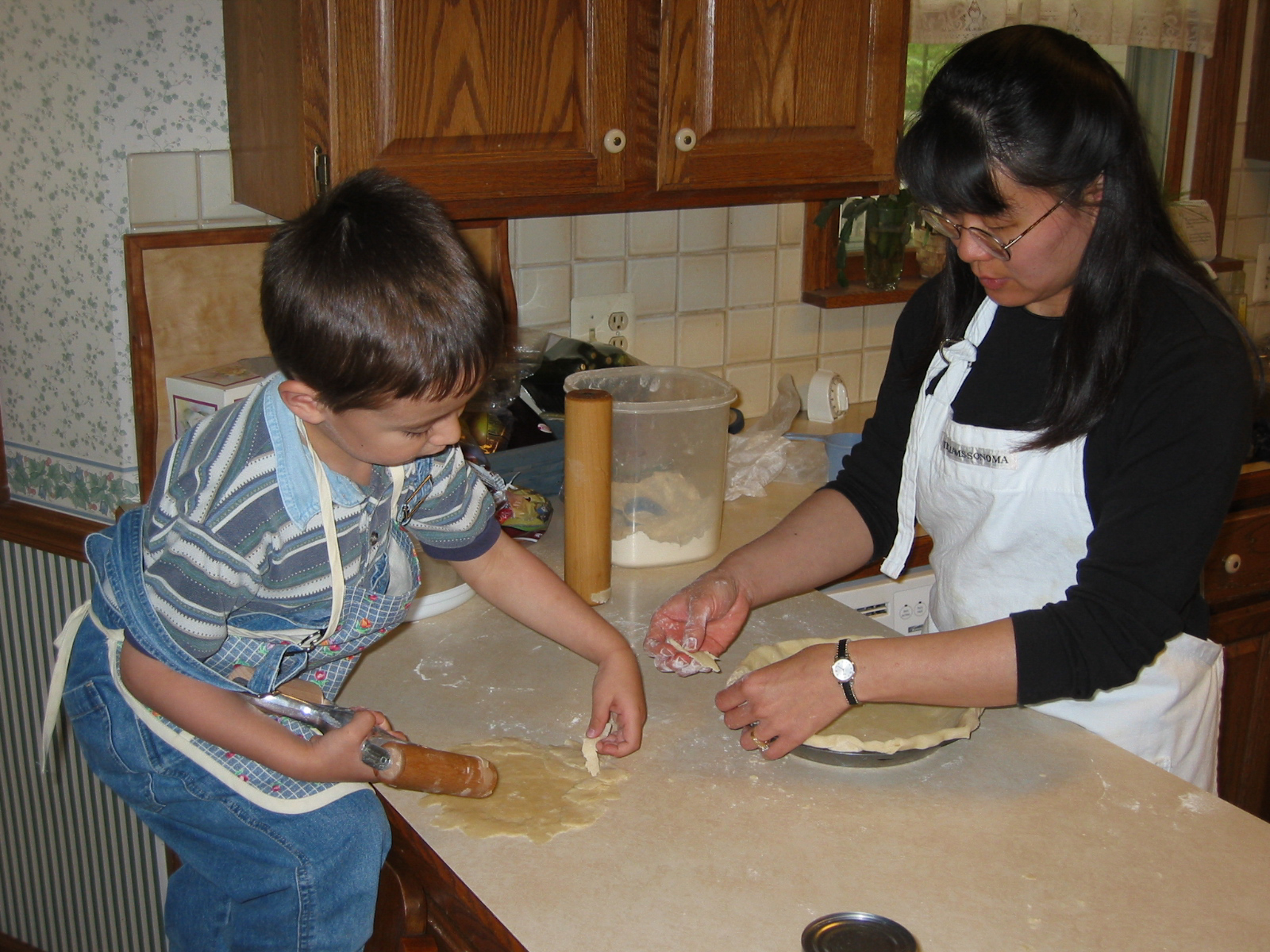
Only one pie crust remains in the freezer. But Penny also taught two of our kids how to carry on the pie making tradition.